
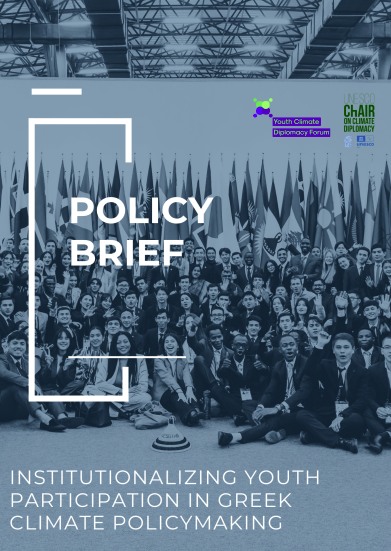
Our first policy brief, published with the UNESCO Chair on Climate Diplomacy, finds that youth participation in Greek climate policymaking is still largely symbolic. It sets out practical reforms to change that.
Young people in Greece are worried about climate change, and they want to act on it. A UNICEF U-Report poll found that most young Greeks fear their future is at risk. Many also feel a strong sense of civic duty. They believe they can and should help improve national climate policy.
So far, the system has given them few ways to do that. This is the starting point of Institutionalizing Youth Participation in Greek Climate Policymaking, a new policy brief by YCDF’s Rania Papadopoulou and Natalia Vradi. Emmanuella Doussis supervised the brief and George Dikaios edited it. YCDF publishes it jointly with the UNESCO Chair on Climate Diplomacy at the National and Kapodistrian University of Athens.
Strong laws, weak delivery
Greece has passed significant climate and environmental legislation. It also has a National Energy and Climate Plan aligned with the European Green Deal. Delivery has been weaker. In the 2026 Climate Change Performance Index, Greece fell eight places to 30th. The main reasons are its continued reliance on fossil gas and the lack of a plan for a just phase-out.
The brief argues that young people could help close this gap. At present, their involvement in climate governance is fragmented, consultative at best and largely symbolic.
Youth structures that exist on paper
Greece has had youth bodies for years. Few of them have lasted, and fewer have had influence.
A 2006 law created Local Youth Councils to advise municipalities. They had no funding, little institutional support and no binding role, and they lay inactive for almost 20 years. In 2025 they were revived. Youth Councils are now mandatory in every municipality with more than 2,000 inhabitants, and they give people aged 17 to 28 a role in local decisions. Several have already been set up. Being mandatory, though, does not give them influence. Their work still has no link to climate policy at higher levels of government.
The National Youth Council, founded in 1998, also fell silent during the financial crisis. It restarted in 2025, but without any specific goals on climate. The General Secretariat for Youth, meanwhile, was folded into the education ministry in 2019. In 2023, now a Youth Directorate, it moved to the Ministry of Social Cohesion and Family Affairs. The brief sees this as a downward trend for youth affairs within government.
None of these bodies has a legal right to be consulted on environmental legislation.
The brief also looks back at 2019. That autumn, Fridays for Future brought thousands of Greek students into squares across the country to demand climate action. It was one of the biggest waves of youth climate activism Greece has seen. With no formal route into policymaking, the momentum faded.
What holds young people back
The barriers go beyond institutions. When climate change is framed as an unmanageable catastrophe, young people can lose hope and disengage. Stories of achievable goals and collective progress bring more of them in. Gaps in climate knowledge, among teachers as well as students, also slow things down.
Money matters too. Greece had a long recovery from the financial crisis, and jobs are insecure while living costs are high. Many young people see activism as a luxury. Where taking part feels like tokenism, some young people withdraw altogether.
The reforms we propose
The brief builds on structures that already exist and draws on good practice from elsewhere in Europe.
A National Youth Climate Council with real powers
The central proposal is a National Youth Climate Council, inspired by Denmark’s Youth Climate Council. It would be set up by law as a permanent advisory body to the Ministry of Environment and Energy. It would review draft climate laws, the National Energy and Climate Plan, adaptation strategies and sector transition roadmaps.
Members aged 18 to 35 would be chosen through open applications, with balance across gender, regions and socio-economic backgrounds. Islands and rural areas would be represented. The Council could submit written opinions, and the government would have to reply within a set timeframe. Its recommendations would be attached to climate bills sent to Parliament, so anyone could see how youth input had been used.
Young people in Greece’s climate delegations
Many European countries include youth delegates in their national teams at UN climate conferences. Greece should do the same. Delegates should be selected transparently and take a full part in policy briefings.
A national dialogue and regional platforms
The brief proposes an Annual National Youth Climate Dialogue, coordinated by the Ministries of Environment, Education and Interior together with the new Council. It would bring together local youth councils, student unions, NGOs and informal youth movements. Its conclusions would shape Greece’s positions in EU climate negotiations.
Regional Youth Climate Platforms would work with regional authorities on adaptation, wildfire management and local sustainability plans. Greece’s islands and fire-prone regions are highly exposed, so local voices matter. These platforms would feed into the national Council and link youth participation from the local to the national level.
Stronger existing structures
Municipal Youth Councils need more responsibility, more funding and more chances to take part. The National Youth Council should set clear goals for youth participation in climate decisions. The Youth Directorate should become a separate General Secretariat for Youth, which would give youth policy more weight in government.
Skills and experience
Participation works best when young people understand how policy is made. The brief calls for climate governance and civic participation modules in upper secondary schools and universities, covering policy processes and legislative drafting. Ministries should also offer paid internships and fellowships in their climate policy teams.
Making it work
The brief is honest about the risks. Without a legal duty to consider youth recommendations, a new council could become a talking shop or a form of “youthwashing”. New local and regional bodies will need staff and resources. Participation schemes tend to attract urban, highly educated and already engaged young people, so reaching rural, island and lower-income youth will take deliberate effort. Coordinating ministries, municipalities, universities and youth organisations will also add complexity. Making the reforms work will take transparent procedures, proper funding, regular evaluation and long-term political commitment.
Why it matters
Greece faces growing climate risks and is falling behind on key transition indicators. Giving young people a formal role in climate policy would make decisions more legitimate and bring longer-term thinking into policy design. It would also bring Greece into line with European and international standards, including the Council of Europe’s 2024 Recommendation on young people and climate action. The brief’s conclusion is that involving young people is a strategic necessity for a fair green transition with broad public support.
What comes next
YCDF is the official constituency for climate matters within the Hellenic National Youth Council. We will use that role to take these recommendations to decision-makers in Greece. We will also bring them to COP31 in Antalya this November.
This is our first policy brief, and we plan to publish more as our work across Southeast Europe grows. If you’d like to work with us on the next one, get in touch.
Suggested citation: Papadopoulou, R. and Vradi, N. (2026) Institutionalizing Youth Participation in Greek Climate Policymaking. Policy brief. Athens: Youth Climate Diplomacy Forum for Southeast Europe and UNESCO Chair on Climate Diplomacy, National and Kapodistrian University of Athens.