
Five things Bloomberg City Lab 2025 taught me about the future of cities
by Eirini Sampson
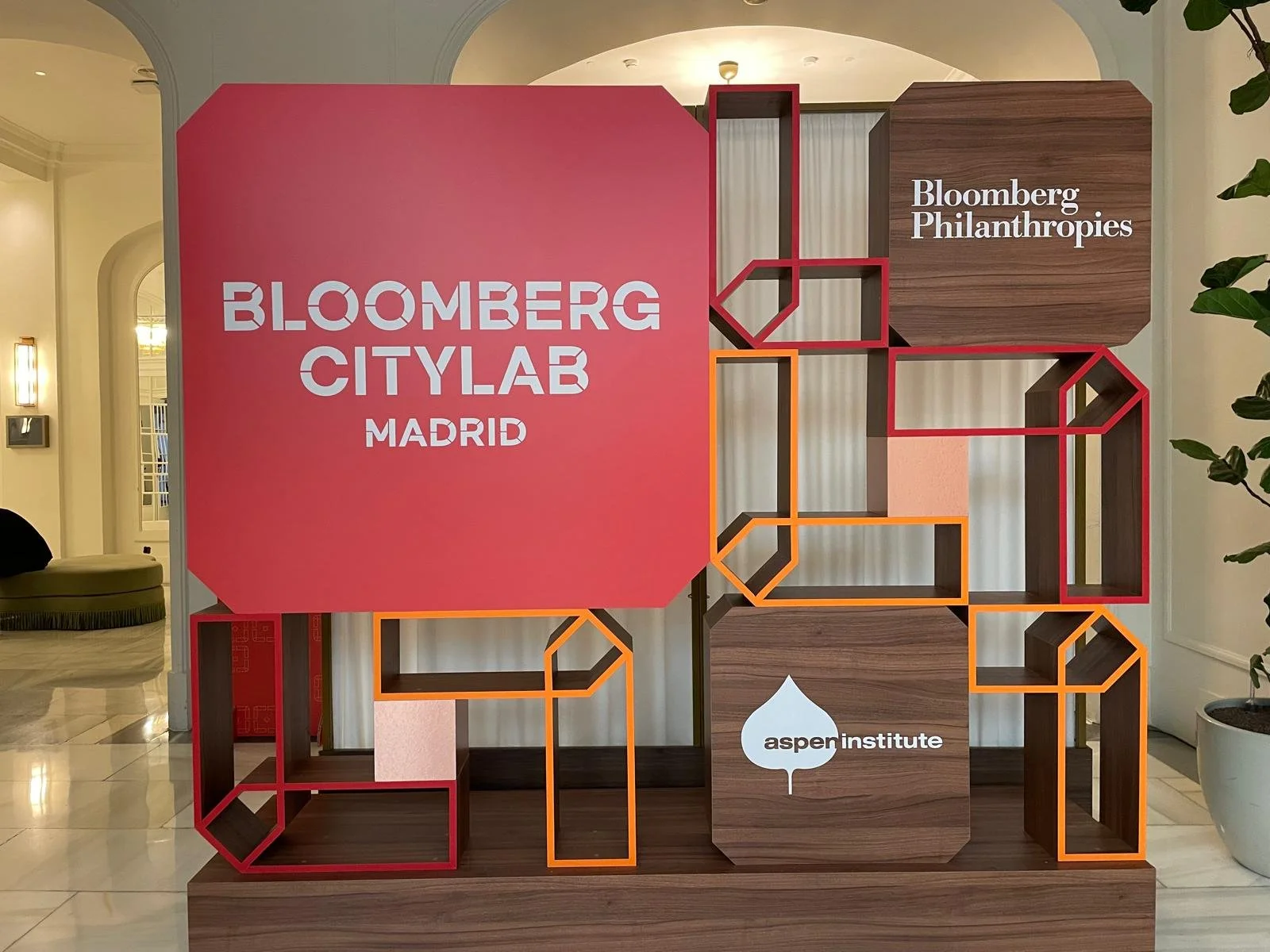
Earlier this month, I had the opportunity to attend Bloomberg City Lab in Madrid — an annual summit convened by Bloomberg Philanthropies and the Aspen Institute that brings together mayors, researchers, technologists and city practitioners from across the world. It is one of the few spaces where the people making decisions about cities at all scales can sit together to exchange, and where the distance between a bold idea and a practical action feels genuinely small.
Here is what I brought home.
1. Cities are moving faster than national governments — and that matters for climate
Time and again, across sessions on housing, AI and climate adaptation, the same pattern emerged: cities are acting where national governments are stalling. Barcelona removed 2,000 apartments from Airbnb to address housing affordability. Bogotá deployed hyper-local air quality sensors to make targeted, neighbourhood-level interventions. Nairobi uses an app to show where air quality is at its worst, and its local leaders can take immediate action. The theme revolves around redesigning cities’ entire urban planning model around live, data-driven diagnosis. The message was clear — if you care about change happening in your lifetime, cities are where to look.
2. Young people are not just a beneficiary group — they are decision-makers
A powerful session on governing across generations featured the city of Kampala's youth desk, which gave young people — who make up 70% of Uganda's population — a formal role in city-wide decision-making. Young people there managed budgets, implemented projects and shaped policy. The gap between that model and the "youth consultation" approach most cities default to was impossible to ignore. The lesson: genuine youth participation is not about including young voices. It is about sharing actual power.
3. AI in government is only as trustworthy as the humans behind it
Almost every panel touched on AI. The most grounded came from practitioners — people who have actually deployed AI tools in city agencies. What they described was less the technology itself and more the institutional work required to make it useful: multidisciplinary teams, community trust-building, bias testing, and constant resistance to vendor capture (the risk that private companies end up making public decisions by proxy). The best AI applications were not replacing human judgment. They were making it sharper.
4. Connection is the thing we are losing most in cities — and it is not inevitable
One of the most unexpected moments of the summit came when a researcher shared an analysis of footage of public spaces across decades. People in cities today move 15% faster through public spaces, are significantly more likely to walk alone, and have fewer spontaneous social encounters than they did 40 years ago. The response from cities in the room was not despair — it was design. How do you build public spaces that pull people back into relationship with each other? The 2026 Paris Olympics torch was offered as one example: a deliberate object of collective attention, visible and unifying. Small, but not nothing.
5. The most important thing in politics right now is rebuilding trust
If Bloomberg City Lab had a single underlying theme, it was this. Whether the conversation was about AI, housing, youth engagement or climate, it always came back to the same question: how do governments become worthy of belief again? The answers offered were practical — govern out loud, show your work, bring community knowledge into city halls, measure outcomes not outputs. But beneath the practicality was something more urgent: a recognition that legitimacy is not given. It has to be built, every day, in the details of how decisions are made and who is in the room when they are.
For those of us working on climate diplomacy, that last lesson is perhaps the most important one to carry forward. The technical challenges of decarbonisation are real, but they are solvable. The political and social infrastructure required to actually implement change — at the pace and scale the climate demands — is what is genuinely at risk. Cities, and the people leading them, are among our best chances of getting this right.
